


Why Your RV's BTU Rating Doesn't Tell the Whole Cold-Weather Story
That 35,000 BTU number printed on your RV furnace? It's the amount of propane energy your furnace consumes, not the heat it actually delivers to your cabin. At a typical 70% efficiency, that furnace pushes roughly 24,500 BTU of warmth into your living space. The rest exits through the exhaust flue.
Cold ambient temperatures, wind, elevation, and a half-empty propane tank all chip away at that already-reduced output. With 25.1 million RV trips logged in 2024 and winter camping growing year over year, more campers than ever are pushing their rigs into cold weather without fully understanding what their appliances can actually deliver. This article gives you a practical framework for the variables that matter most when temperatures drop.
BTU Input vs. Output: The Rating Your Furnace Manufacturer Doesn't Explain
A BTU, or British Thermal Unit, is the energy required to raise one pound of water by one degree Fahrenheit. Manufacturers rate RV furnaces in input BTUs because it describes the total fuel energy consumed. It's a standardized measurement, but it tells you nothing about how much heat reaches your cabin.
Most RV furnaces operate between 60% and 85% thermal efficiency. Legacy models from well-known brands have hovered around 60% for decades, meaning up to 40% of your propane goes straight out the exhaust. Even a well-maintained modern furnace at 70% efficiency loses nearly a third of its fuel energy.
Here's what that looks like in practice: a 30,000 BTU furnace running at 70% efficiency delivers approximately 21,000 BTU to the cabin. That furnace burns roughly one-third gallon of propane per hour of continuous operation. In real winter conditions (outdoor temps in the 30s°F, thermostat set to 65°F), most RVers report using 1 to 1.5 gallons per day.
The standard sizing rules of thumb are helpful starting points:
- 25–30 BTU per square foot for mild climates
- 45–60 BTU per square foot for cold climates
- ~1,000 BTU per foot of RV length, adjusted for insulation quality
The critical point: comparing two furnaces by BTU rating alone is misleading if you don't know the efficiency of each unit. A 35,000 BTU furnace at 60% efficiency delivers 21,000 BTU. A 30,000 BTU furnace at 85% efficiency delivers 25,500 BTU. The nominally smaller furnace actually heats your RV better.
BTU Lockout Is a Sliding Scale, Not an On/Off Switch
Propane has an absolute boiling point of -44°F (-42°C). Below that temperature, liquid propane physically cannot vaporize into gas, and your appliances will not function at all. That's the hard floor.
The real story starts long before -44°F. BTU delivery degrades progressively as temperatures fall, beginning around 40°F as vaporization slows. Think of it as a dimmer switch, not a light switch.
The pressure-temperature relationship tells the story clearly:
- 20°F: ~47 psi
- 0°F: ~28 psi
- -20°F: ~13 psi
- -30°F: ~8 psi
Every one of those readings is well above the -44°F lockout floor, yet available fuel pressure drops dramatically at each step. High-BTU appliances need consistent pressure to operate at full capacity, and they simply can't get it as temperatures fall.
Tank fill level compounds the problem. A 30-lb propane tank at 60% full produces approximately 50,400 BTU/hr at 20°F. Drop the temperature to 0°F with the same tank, and output falls to roughly 25,200 BTU/hr. That's a 50% reduction with no change in fuel level.
The worst-case scenario, and the most common real-world BTU starvation event, combines three factors: a low tank fill level, cold ambient temperatures, and running your furnace and water heater simultaneously. Both appliances compete for the same limited vaporization capacity, and neither gets enough fuel to perform properly.
It's important to distinguish between two distinct failure modes. Ignition lockout means the appliance won't start at all because fuel pressure is too low to sustain a flame. Partial BTU starvation is more subtle: the appliance fires and runs, but it can't maintain your setpoint temperature because it's receiving less fuel than it needs. The furnace cycles endlessly, your cabin stays cold, and you burn through propane faster because the system never reaches equilibrium.
Freeze Thresholds: Not All RV Components Hit the Wall at the Same Temperature
Different parts of your RV's water system are vulnerable at different temperatures. Understanding this hierarchy helps you prioritize protection where it matters most.
Tier 1: Tankless Water Heater Lines (~35–38°F)
Quality RV tankless water heaters activate automatic freeze protection when internal water line temperatures drop to this range. The Fogatti InstaShower 8 Plus, for example, fires its burner automatically to warm the lines to approximately 90°F, then shuts down. No manual intervention required. This is your first line of defense, and it activates well before actual freezing occurs.
Tier 2: Exposed Pipes and Underbelly Plumbing (Teens °F)
Unprotected pipes in your RV's underbelly can begin to freeze within a few hours when temperatures drop into the teens. A single overnight low in the mid-20s°F is enough to freeze exposed pipes or partially filled lines.
Tier 3: Holding Tanks and Sustained Sub-Zero Exposure (Below 20°F)
Sustained temperatures below 20°F put holding tanks and any unprotected water source at serious risk. The larger volume of water in holding tanks provides some thermal mass, but prolonged exposure overwhelms it.
RV skirting is a critical modifier for all three tiers. In a documented 48-hour test at 20°F, a skirted RV consumed 28% less propane than an unskirted unit maintaining the same interior temperature. Skirting reduces furnace BTU demand by 20–35% overall by blocking wind from contacting the underbelly, pipes, and tanks.
One hidden freeze risk that rarely gets attention: propane regulators. Moisture inside the regulator can ice over during rapid vaporization cycles, cutting fuel supply entirely. This can mimic an empty tank or a furnace malfunction, and it happens without warning.
Wind Chill: The Invisible Performance Killer for Propane Tanks and Water Heaters
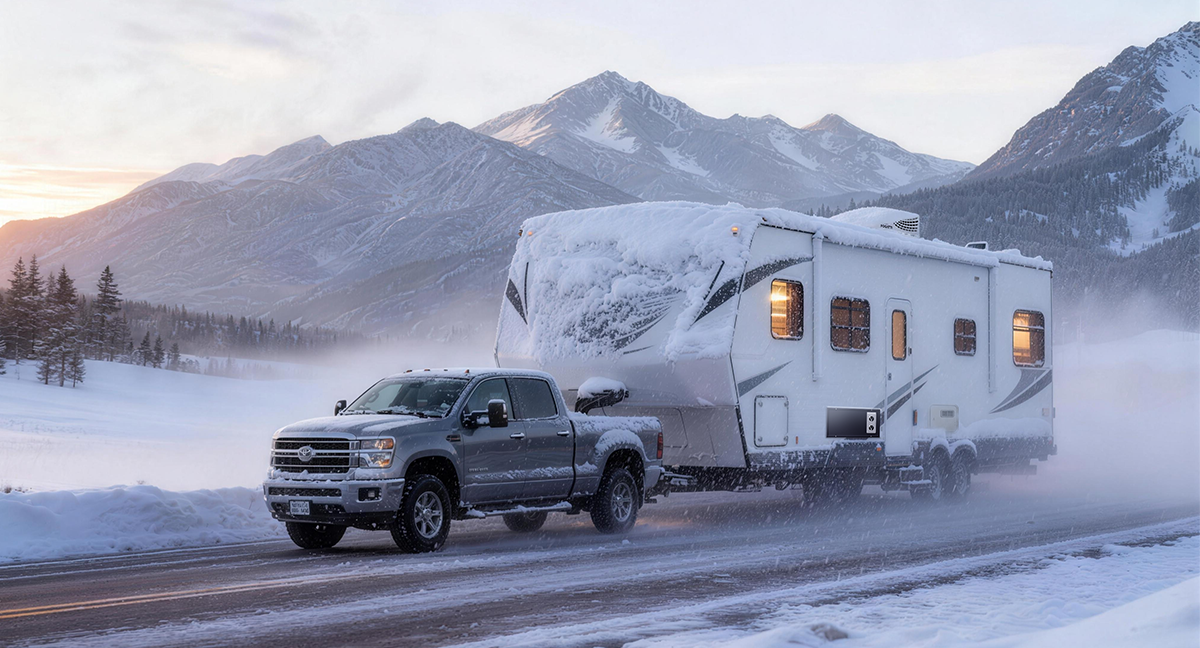
Wind chill gets plenty of attention when it comes to human comfort, but it's almost never discussed in the context of RV appliance performance. It should be. Wind is one of the primary real-world failure modes for winter campers.
The mechanism is straightforward: wind accelerates heat loss from propane tanks and appliance compartments. Your thermometer might read 25°F, but your propane tank, exposed to a steady 15 mph wind, is losing heat as if it were sitting in much colder air. Vaporization rate drops below what the ambient temperature would suggest, and your appliances starve for fuel.
Wind also disrupts combustion in outdoor-vented appliances. Traditional RV furnaces rely on sail switches, a decades-old airflow detection mechanism, to verify adequate airflow before allowing ignition. Dust, debris, or inconsistent airflow caused by wind gusts can prevent the sail switch from closing, locking out the furnace entirely. This is one of the most frequently reported furnace failure modes in cold and windy conditions.
Modern alternatives exist. The Fogatti InstaHeat Ultra 35,000 BTU furnace replaces the traditional sail switch with an electronic wind pressure sensor that adjusts combustion parameters in real time, and it's rated to maintain performance in wind gusts up to 30 mph. That directly addresses the failure mode that has plagued RV furnaces for years.
The skirting data reinforces the point: that 28% propane reduction in the 48-hour test at 20°F is a direct measurement of wind chill's impact on furnace BTU demand. Block the wind, and your furnace works less to maintain the same temperature.
The Elevation Factor: A Compounding Cold-Weather Penalty Overlanders Can't Ignore
For every 1,000 feet of elevation gain, a gas appliance loses approximately 4% of its rated BTU output due to reduced oxygen availability for combustion. That penalty adds up fast.
A 30,000 BTU furnace at 8,000 feet elevation is already operating at roughly 25,200 BTU output before you factor in cold-weather propane pressure losses. Stack altitude on top of a cold night with a half-empty tank, and you're looking at a furnace delivering a fraction of its rated capacity.
Solar panel output also drops 20–30% in winter due to shorter days and lower sun angles, reducing the power available for furnace blower fans. This adds an electrical dimension to the cold-weather challenge that's easy to overlook.
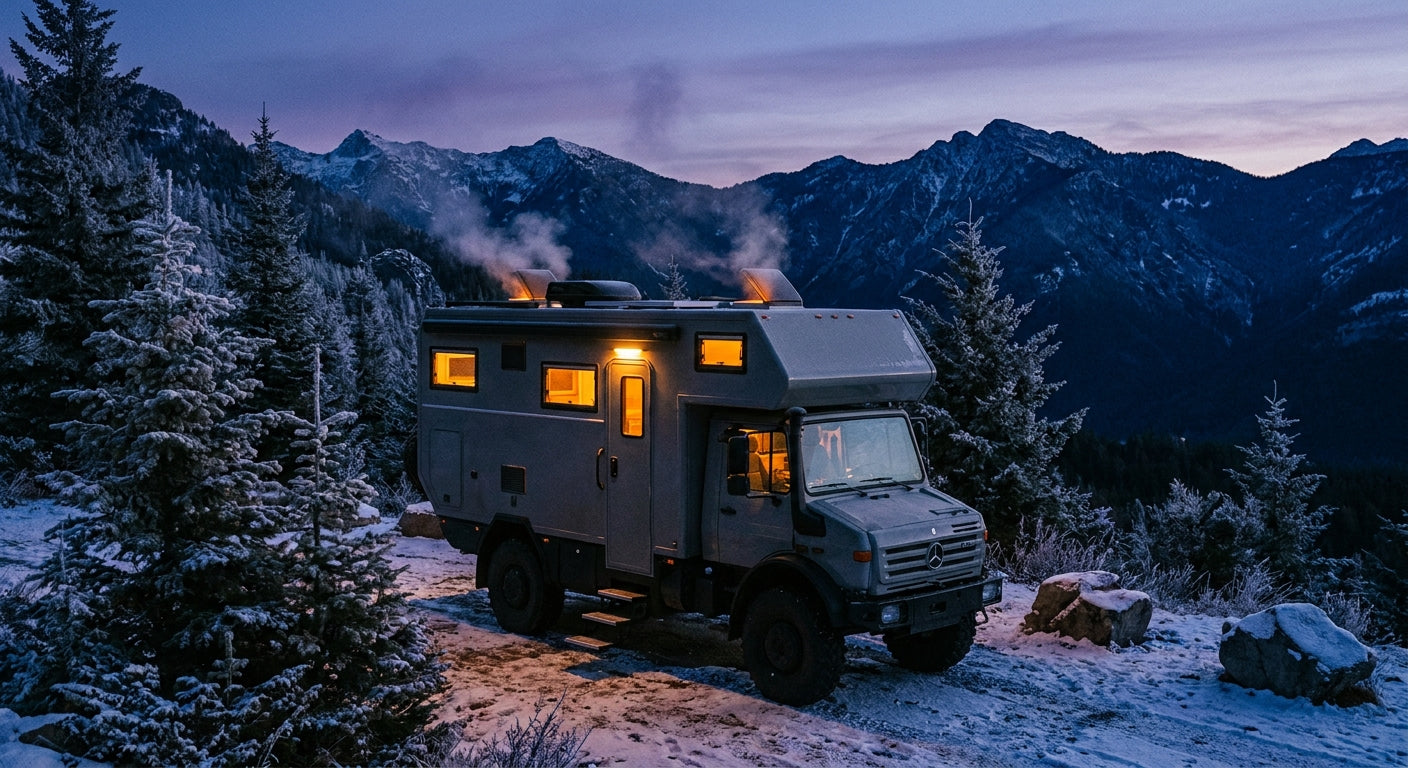
Overlanders and mountain winter campers face the toughest combination: altitude BTU loss, extreme cold propane pressure drop, and wind exposure all hitting simultaneously. If you regularly camp above 5,000 feet in winter, size up your furnace BTU capacity accordingly. The standard sizing rules assume sea-level performance.
What to Do With This Information: Practical Cold-Weather Performance Checklist
A concrete checklist built from everything above:
- Use larger propane tanks when possible. A 40-lb cylinder at 20°F produces approximately 21,800 BTU/hr, compared to only 13,000 BTU/hr from a 20-lb cylinder at 25% fill under identical conditions.
- Keep tanks above 40% fill in cold weather to maintain adequate vaporization pressure. Remember that propane contracts in cold temperatures, making gauges read lower without actual volume loss.
- Install RV skirting before sustained cold-weather camping to reduce furnace BTU demand by 20–35% and protect underbelly plumbing from wind exposure.
- Verify your water heater has automatic freeze protection that activates without manual intervention. Not all units include this feature. The Fogatti InstaShower 8 Plus is specifically designed for shoulder-season and winter use.
- Check that your furnace uses an electronic wind pressure sensor rather than a traditional sail switch if you camp in exposed or windy locations.
- Account for elevation: add approximately 4% BTU capacity per 1,000 feet above sea level when sizing or evaluating your furnace.
- Inspect your propane regulator for signs of moisture exposure or icing before winter camping season. Replace it if there's any doubt.
Know Your Numbers Before the Temperature Drops
BTU ratings are a starting point, not a guarantee. Real cold-weather performance depends on efficiency, tank fill level, ambient temperature, wind chill, and elevation working together. A single number on a spec sheet can't capture that complexity.
Once you understand these variables, you can plan for them. Use a BTU calculator or sizing tool to match your furnace and water heater capacity to your specific RV size, climate zone, and camping style.
Since 2003, Fogatti has served over 800,000 customers across 80+ countries and earned the trust of OEM partners including Thor Industries, Forest River, and Coachmen. Our engineering approach, from electronic wind pressure sensors to automatic freeze protection and high-BTU tankless technology, is purpose-built for the real-world cold-weather variables covered in this article.
Understanding these numbers puts you in control. Four-season travel doesn't have to mean guesswork. It means knowing what your equipment can deliver and planning accordingly.
Ready to find the right setup for your rig? Try Fogatti's RV Water Heater Calculator and explore our full lineup of cold-weather-ready RV appliances.