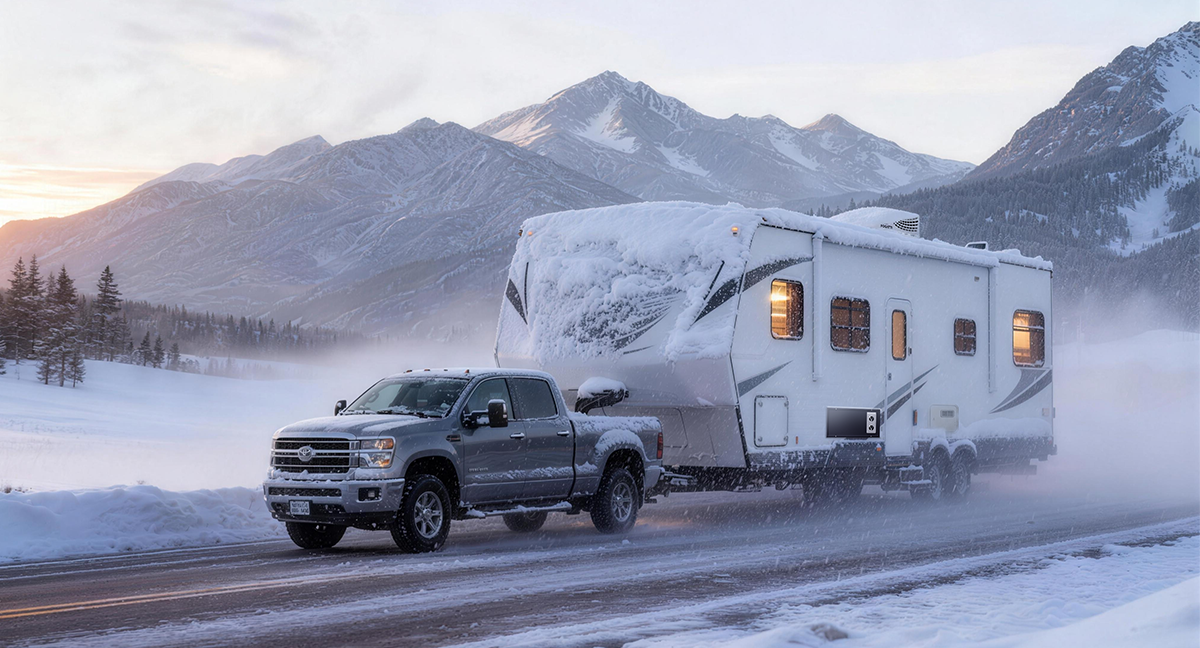




Your RV Furnace Doesn't Run on Propane at Night — It Runs on Your Battery
Here's the misconception that catches people off guard every winter: your propane furnace provides the heat, but your 12V battery powers everything that makes combustion possible. The blower motor, the spark electrode ignition, the control board, and every safety sensor in the system all draw from your battery bank.
Without adequate 12V voltage, your furnace cannot ignite or stay lit, even with a full propane tank sitting right there. That means you're managing two completely separate resources off-grid: propane consumption and battery drain. At 25°F outside, those two systems are racing against each other all night long.
This matters more than most RVers realize. About 28% of regular campers attempted winter camping in 2023–2024, up from just 18% in 2020–2021. Boondocking search volume has surged 340% since 2020. More people are heading out in cold weather, and understanding this dual-fuel reality is the difference between sleeping warm and waking up to a dead furnace at 3 AM.
The Three-Phase Draw Most RVers Never Account For
Most guides give you a single amp figure for your furnace and call it a day. That's incomplete. Your furnace's electrical demand breaks into three distinct phases, and each one matters for accurate planning.
Phase 1: Standby/Idle (0.5–2A). Even when the furnace isn't actively heating, the control board and thermostat are polling. They're checking temperature, monitoring safety sensors, and waiting for the call to fire. This draw is small but continuous, running all night whether the burner is lit or not.
Phase 2: Running/Continuous (3–12A). This is the blower motor doing its job. The range is wide because furnace size matters enormously. An Atwood 7912–7919 series (now under the Dometic umbrella after their 2016 acquisition of Atwood) draws about 3.4A. A Suburban SF-20, SF-25, or SF-30 pulls roughly 6A. Larger units rated above 35,000 BTU can draw 7–12A continuously.
Phase 3: Ignition Spike (5–20A). Every time your furnace cycles on, the startup sequence demands a brief but significant surge of current. This inrush can cause voltage drops that affect other 12V components throughout your RV. If your battery is already marginal, this spike alone can push voltage below the threshold where the furnace refuses to fire.
Understanding all three phases gives you a far more accurate picture of overnight consumption than any single-number estimate.
Duty Cycle: The Real Multiplier That Determines Your Overnight Ah Consumption
Amp draw tells you how much power the furnace uses while running. Duty cycle tells you how much of the hour it actually runs. That percentage is the real multiplier.
Here's the math. At a 25% duty cycle (furnace running 15 minutes per hour) with an 8A draw, you consume 2 Ah per hour. Over an 8-hour night, that's 16Ah. Manageable for most setups.
Now bump that to a 50% duty cycle (30 minutes per hour), which is realistic when overnight lows drop into the 20s. Consumption doubles to 4 Ah per hour, or 32Ah overnight. That's a serious problem for a factory battery.
Colder temperatures force higher duty cycles. Your furnace runs longer per hour precisely when your battery is already delivering less capacity. The core formula is: (Battery Ah × Usable %) ÷ Furnace Amps = Estimated Hours. Duty cycle is the multiplier that makes or breaks the result. Skip it, and your calculations are fiction.
The Cold Night Double Penalty: Why Your Battery Is Already Losing Before the Furnace Starts
Cold nights hit you from both sides. Your furnace demands more power because it cycles more frequently, and your battery delivers less power because cold chemistry is slower chemistry. Most guides address these separately. In reality, they compound into a single system failure.
The capacity loss data is stark. At 32°F, a lead-acid battery loses 20–30% of its rated capacity compared to its performance at 77°F. At 0°F, that loss climbs to 30–40%. At -22°F, you're looking at a 50% reduction.
In practical terms, a 100Ah lead-acid battery at 70°F may only deliver 60–70Ah when temps drop below freezing, and that's before accounting for any other penalty.
Then there's the Peukert Effect. High-amp draws reduce effective capacity on lead-acid batteries beyond what the rating suggests. A 100Ah lead-acid at a 50A draw may only deliver 70–80Ah effectively. LiFePO4 batteries are nearly immune to this effect, which is one reason they perform so differently in the field.
There's also the voltage cutoff trap. When battery voltage drops below approximately 10.5–11V, the furnace's safety system shuts it down. A battery monitor showing 30% charge may already be too low to fire the furnace. Percentage readings lie; voltage doesn't.
Here's the worst-case worked example: a 100Ah lead-acid at 20°F. Apply the 50% depth-of-discharge limit, and you have 50Ah usable. The cold temperature penalty reduces that to roughly 35Ah effective. Factor in the Peukert Effect at an 8A furnace draw, and real runtime may be 3–4 hours, not the 6.5 hours an ideal-conditions calculator would show. Your furnace dies before sunrise.
Full System Load Stacking: The Furnace Isn't Your Only Drain
The furnace is the biggest 12V load overnight, but it's not the only one. Parasitic and concurrent loads silently compete for every amp-hour in your battery bank.
Common overnight draws include your propane detector and CO alarm (2–5A combined, running continuously), your fridge control board (roughly 0.8A, adding up to 6.4Ah over 8 hours), water pump cycles, thermostat and control panels, and stereo memory draw.
Stack it up for a realistic cold night: furnace at 50% duty cycle (32Ah) plus fridge board (6.4Ah) plus detectors (16–40Ah) equals 54–78Ah total over 8 hours.
Now compare that against factory equipment. Most RVs ship with a single Group 24 battery rated at 70–85Ah. After applying the 50% DoD limit on lead-acid, you have 35–42Ah usable. That battery is fundamentally undersized for even one cold night.
Serious off-grid setups typically require 200–400Ah of lithium or 400–600Ah of AGM to support multiple days of furnace use in cold weather without recharging.
LiFePO4 vs. Lead-Acid in Winter: It's Now a Safety Debate, Not Just a Cost Debate
The battery chemistry conversation has shifted. In winter conditions, choosing between LiFePO4 and lead-acid isn't just about price per amp-hour. It's about whether your system can keep you safe through the night.
Lead-acid batteries limit you to 50% depth of discharge. LiFePO4 can safely discharge to 80–90% DoD, effectively doubling your usable capacity for the same rated Ah. That's a significant advantage when every amp-hour counts.
Here's a critical safety fact: a discharged lead-acid battery can freeze solid at 20°F, causing permanent damage. A fully charged lead-acid won't freeze until about -55°F. Draining your lead-acid to keep the furnace running actually puts the battery itself at risk of destruction.
LiFePO4 can safely discharge in cold weather without damage. However, it cannot be charged below 32°F without a heated battery management system. That creates a morning trap: if you drain your lithium bank overnight and wake to sub-freezing temps, you cannot recharge until the battery warms up. Plan your solar timing accordingly, or invest in a heated battery compartment.
Also consider age. A three-year-old lead-acid may only hold 70–80% of its original rated capacity, compounding every other penalty discussed above. Battery placement matters too: batteries stored in unheated exterior compartments lose capacity faster than those kept in heated interior spaces.
How to Calculate Whether Your 12V System Can Handle a Cold Night
Here's a step-by-step framework you can apply to your own setup tonight.
- Find your furnace's continuous amp draw. Check the label or manual. Reference points: Atwood 7912–7919 at 3.4A, Suburban SF-20/25/30 at ~6A, larger 35,000+ BTU units at 7–12A.
- Estimate your duty cycle based on expected overnight low. Light cycling at 45°F (roughly 20–25%). Heavy cycling at 20°F (40–60%).
- Calculate furnace Ah consumption: Amps × Duty Cycle % × Hours = Furnace Ah.
- Add concurrent loads: fridge board, detectors, lights, panels. Typically 10–15Ah additional over 8 hours.
- Calculate true usable battery capacity: Rated Ah × DoD % × Cold Temperature Penalty % × Age Factor %.
- Compare total demand vs. true usable capacity. If demand exceeds capacity, the furnace shuts down before morning.
Worked example at three temperature tiers (100Ah lead-acid, Suburban SF-25 at 6A, 8-hour night):
- 45°F: 25% duty cycle = 12Ah furnace + 12Ah other loads = 24Ah demand. Usable capacity ~45Ah. You make it through the night.
- 32°F: 40% duty cycle = 19.2Ah furnace + 12Ah other loads = 31.2Ah demand. Cold penalty drops usable capacity to ~35Ah. Borderline — you might wake up cold.
- 20°F: 55% duty cycle = 26.4Ah furnace + 15Ah other loads = 41.4Ah demand. Cold penalty plus Peukert drops usable capacity to ~28Ah. Your furnace fails before 3 AM.
One final note: monitor actual voltage, not percentage. Your furnace needs 10.5–11V minimum to operate. A percentage gauge can mislead you. Voltage tells the truth.
Build Your System to Handle the Cold — Not Just the Catalog
Everything in this article points to four upgrade priorities for reliable off-grid winter camping:
- Battery bank: Upgrade from the factory Group 24 to a minimum 200Ah LiFePO4 for reliable single-night furnace use in cold weather. That single upgrade changes the math entirely.
- Voltage monitoring: Install a battery monitor that displays actual voltage, not just a percentage bar. You need to catch the 10.5–11V danger threshold before the furnace shuts off, not after.
- Understand solar's real role: Solar is a daytime offset, not a nighttime solution. Winter campers often overestimate solar contribution in cold or cloudy conditions. Your overnight reserves need to stand on their own.
- Know your furnace's three-phase draw and duty cycle before your first cold night, not after you wake up shivering.
At Fogatti, we've spent over two decades engineering RV comfort systems trusted by more than 800,000 customers and OEM partners including Thor Industries, Forest River, and Coachmen. Reliable, home-like comfort on the road starts with understanding your full 12V system, not just the appliance specs. Explore our RV HVAC resources and product lineup for systems built with energy efficiency and off-grid reliability at their core.