


By: Johnny Walker
Why Most RV Owners Miscalculate Their Propane (And Run Out at the Worst Time)
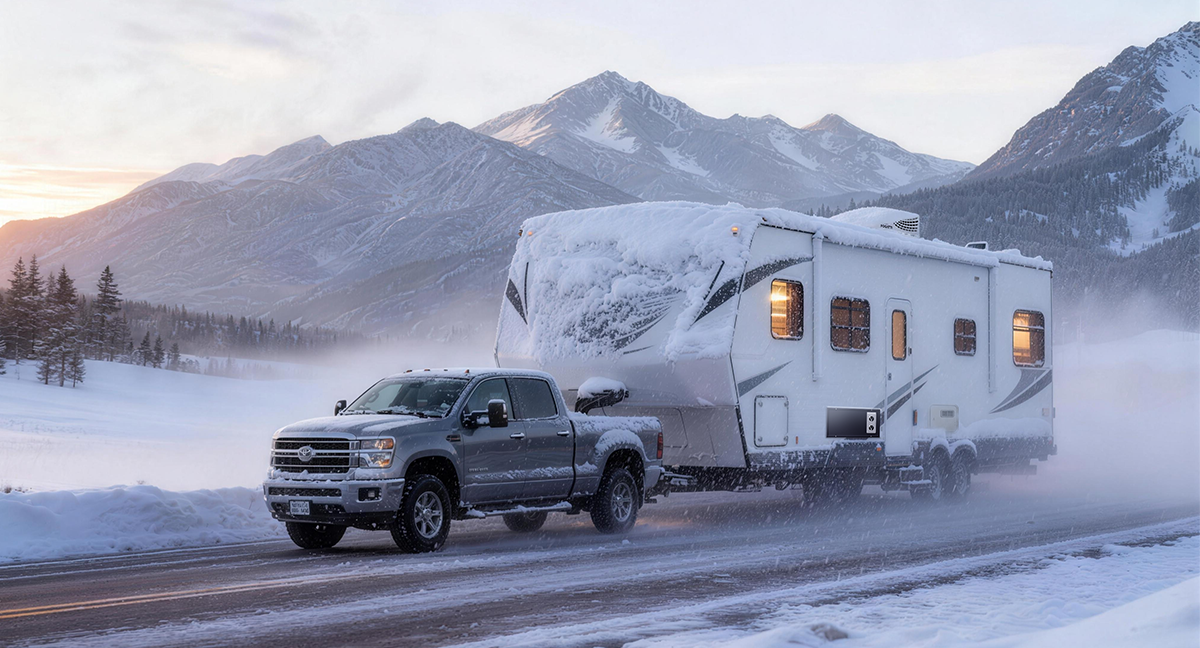
Running out of propane at midnight in 20°F weather isn't bad luck. It's bad math.
Here's the core problem: most propane guides calculate consumption as if your appliances run at 100% output, 100% of the time. That dramatically overstates real-world usage and leaves you either hauling way too much propane or, worse, running dry when you need it most.
Your RV has three main propane consumers: the furnace, the water heater, and the cooktop. The difference in consumption between them is staggering, and understanding that hierarchy is the key to accurate planning.
Before we dive in, let's establish the universal constant that underpins every calculation in this article: 1 gallon of propane = 91,500 BTUs. That's the industry-standard energy baseline. Here's the detail most owners miss: propane tanks can only be safely filled to 80% capacity to allow for gas expansion. That means your "20 lb tank" actually holds about 4.7 usable gallons, not the full theoretical amount. With 11.2 million RV-owning households across the U.S., a lot of people are getting this wrong.
The Master Formula: How to Calculate Propane Use for Any RV Appliance
Every propane calculation starts with one simple formula:
Gallons Per Hour = Appliance BTU Rating ÷ 91,500
Let's walk through a real example. Say your RV furnace is rated at 30,000 BTU. Divide that by 91,500 and you get 0.328 gallons per hour at full output. Simple enough. But here's where most guides stop, and where they get it wrong.
The missing variable is the duty cycle. Your furnace doesn't run continuously. It cycles on and off based on your thermostat setting, outdoor temperature, and your RV's insulation quality. A typical duty cycle ranges from 30% to 60%. According to North NJ HVAC, factoring in duty cycle is what separates theoretical calculations from real-world accuracy.
Here's the adjusted math: that same 30,000 BTU furnace at a 40% duty cycle actually consumes 0.328 × 0.40 = ~0.131 gallons per hour. That's less than half the "worst case" number most guides publish.
Now multiply by hours of use. Running that furnace for 8 hours overnight: 0.131 × 8 = ~1.05 gallons for a full night of heating. With propane costing roughly $3 to $5 per gallon, that's about $3 to $5 per night. Not bad when you know the real numbers.
Appliance-by-Appliance Propane Breakdown: Furnace, Water Heater, and Cooktop
Think of your RV's propane consumption as a hierarchy. The furnace dominates, the water heater is secondary, and the cooktop barely registers. Here's a quick reference table:
- RV Furnace: 10,000 to 40,000 BTU/hr | 30 to 60% duty cycle | 0.13 to 0.44 gal/hr actual
- Tank Water Heater (6-gal): ~8,800 BTU/hr | Cycles 2 to 4 hrs/day | ~0.10 gal/hr
- Tankless Water Heater: 41,000 to 66,000 BTU/hr | Fires on demand only | ~0.20 gal per typical day
- Cooktop: 6,000 to 9,000 BTU/hr per burner | ~0.06 to 0.10 gal/hr
RV Furnace: The Biggest Propane Drain
RV furnaces range from 10,000 to 40,000 BTU per hour. Smaller trailers and vans typically run 10,000 to 20,000 BTU units, while larger motorhomes need 30,000 to 40,000 BTU or more. The general rule of thumb, as noted by The RV Geeks, is about 1,000 BTUs per linear foot of RV. A 30-foot rig needs roughly a 30,000 BTU furnace.
At full burn, that 30,000 BTU furnace consumes approximately 0.328 gallons per hour. With a realistic 40% duty cycle, actual consumption drops to around 0.131 gallons per hour. In cold weather with frequent cycling, expect 4 to 8 lbs of propane per day for heating alone.
Now consider the extreme end: a 40,000 BTU furnace running at a 60% duty cycle averages roughly 6.3 gallons per day in winter conditions. That demands large tanks or frequent refills for extended cold-weather stays.
To put this in perspective, according to CrunchMilk, running a furnace for 8 hours uses as much propane as running a propane fridge for nearly a full week. That's why furnace management is the single most important lever for boondockers.
Fogatti's RV furnace lineup is engineered to optimize BTU output and duty cycle performance, delivering reliable heat while keeping propane consumption in check. If your furnace is aging or undersized, an upgrade can make a measurable difference in your propane budget.
RV Water Heater: Tank vs. Tankless Propane Tradeoff
Traditional 6-gallon tank water heaters consume approximately 8,800 BTU per hour and cycle on and off throughout the day to maintain stored water temperature. According to RV Cost Calculator, they typically run 2 to 4 hours per day total.
Tankless water heaters have much higher BTU ratings (41,000 to 66,000 BTU per hour) but only fire when hot water is actively flowing. This is the counterintuitive truth that trips up most RV owners: a higher BTU rating doesn't mean more propane consumed. It means the unit fires for fewer total minutes per day.
Let's do the math. A tank heater cycling 3 hours per day at 8,800 BTU uses approximately 0.29 gallons per day. A tankless unit firing for 20 minutes at 55,000 BTU uses approximately 0.20 gallons per day. Tankless wins on efficiency for typical shower habits.
The Fogatti InstaShower 8 Plus delivers 55,000 BTUs with a maximum flow rate of 2.9 GPM and features staged combustion technology that conserves propane on extended trips. It's built for RV owners who want maximum hot water output with minimal waste.
For those upgrading from a standard 6-gallon tank unit, the Fogatti InstaShower 7 delivers 1.58 GPM of continuous hot water on demand, runs on propane with 12V DC ignition, and installs directly into a standard 6-gallon cutout. It's one of the most popular tankless RV water heater choices on the market.
As a trusted OEM supplier for major RV manufacturers including Thor Industries, Forest River, and Coachmen, Fogatti builds these units to the same standards that go into factory-installed systems. Every InstaShower unit comes with a free 24-month warranty and dedicated phone technical support.
RV Cooktop: The Smallest Propane Consumer
Standard cooktop burners use about 6,000 BTU per hour, high-output burners reach around 9,000 BTU per hour, and the oven burner runs at roughly 2,200 BTU per hour. At full output, your burners consume only 0.06 to 0.10 gallons per hour, making cooking the smallest propane consumer by a wide margin.
A typical meal cooked in 30 to 60 minutes barely registers on your tank gauge. Here's a number that puts it in perspective: cooking three meals per day for an entire week uses less propane than one cold night of furnace heating.
To squeeze even more efficiency out of your cooktop, use lids on pots, match your burner size to your cookware, and batch-cook meals to minimize total burn time. These small habits add up over a long trip.
Real-World Propane Scenarios: How Long Will Your Tank Actually Last?
Let's put all this math into practical scenarios you can plan around.
Scenario 1: Summer cooking-only trip. With only the cooktop and water heater running, a 20 lb tank (4.7 usable gallons) can last 2 to 4 weeks. This is the sweet spot for warm-weather camping where the furnace stays off.
Scenario 2: Mild fall weekend with light furnace use. Running the furnace overnight at a 30% duty cycle, plus normal cooking and water heating, that same 20 lb tank lasts approximately 5 to 7 days.
Scenario 3: Winter boondocking with heavy furnace use. This is where propane disappears fast. A 20 lb tank may last only 3 to 5 days. According to Boondocker's Bible, experienced boondockers can stretch one tank to two weeks by minimizing furnace use and switching to a high-efficiency tankless water heater. A 30 lb tank (about 7 usable gallons) with moderate usage (furnace 8 hrs/day, fridge 24 hrs, stove 1 hr, water heater 2 hrs) lasts approximately 5 to 8 days.
Remember the 80% fill rule: that "30 lb tank" holds roughly 7 usable gallons, not the full theoretical capacity. Don't overlook cold-weather pressure dynamics either. According to Complete Calculators, below 20°F you should keep tanks at least 30% full for adequate pressure. Below 0°F, NW Adventure Rentals notes that tank BTU capacity can drop by 50% or more.
Winter heating increases total propane usage by 5 to 10x compared to summer. Seasonal planning isn't optional for full-timers and cold-weather campers; it's essential.
Propane Management Tips to Stretch Every Gallon on the Road
When your tank is running low, prioritize the propane hierarchy: reduce furnace use first (the largest consumer), then adjust water heater habits, then cooking last. Use electric blankets or heated mattress pads to reduce furnace duty cycle overnight. This is one of the most effective propane-saving strategies for boondockers.
Upgrading from a tank water heater to a Fogatti InstaShower tankless unit can cut daily water heating propane use by 20 to 30% based on the BTU comparison outlined above. For extended off-grid trips where propane conservation is critical, the Fogatti InstaShower 8 Plus with staged combustion is purpose-built for the job.
Monitor your tank levels proactively. As noted by Camping World, propane tanks manufactured after 1998 have an OPD (overfill prevention device) but no built-in gauge. Use a propane tank scale or inline gauge for accurate readings. In cold weather, keep tanks at least 30% full and store them vertically to maintain pressure flow.
Not sure which water heater matches your rig and propane efficiency goals? Fogatti's RV Water Heater Calculator tool can help you find the right fit in minutes.
Do the Math Before You Leave the Driveway
Here's your takeaway formula: Gallons Per Hour = Appliance BTU ÷ 91,500, adjusted by duty cycle and multiplied by hours of use. That's the math that separates confident propane planning from midnight surprises.
Remember the propane hierarchy: furnace dominates, water heater is secondary, cooktop is minimal. When you need to conserve, you now know exactly which lever to pull first.
Don't forget the two most commonly overlooked planning variables: the 80% fill rule (your tank holds less than you think) and cold-weather pressure drop (your tank delivers less than it should when temperatures plummet).
Use Fogatti's RV Water Heater Calculator to find the right tankless unit for your rig and propane efficiency goals. Precise propane math means more nights off-grid, more comfort on the road, and zero midnight surprises.
Ready to upgrade your hot water system and save propane on every trip? Explore the Fogatti InstaShower 7 for a seamless tank-to-tankless upgrade, or step up to the Fogatti InstaShower 8 Plus for maximum performance with staged combustion efficiency. Every unit ships free within 1 business day and is backed by a free 24-month warranty and dedicated phone technical support. Your next adventure deserves better math and better hot water.
Sources
- RV Statistics for 2025 — Emergency Assistance Plus
- How Much Propane an RV Furnace Uses — North NJ HVAC
- How Long Does an RV Propane Tank Last? — Foster Fuels
- How Much Propane Does an RV Furnace Use? — The RV Geeks
- How Much Propane Does an RV Furnace Use? — Do It Yourself RV
- RV Propane Calculator — CrunchMilk
- RV Propane Usage Per Day Calculator — RV Cost Calculator
- RV Tankless Water Heater Guide — HeatedGear360
- Tankless vs Tank RV Water Heater — The RV Surplus
- How Long Will a Propane Tank Last While Boondocking? — Boondocker's Bible
- RV/Van Life Propane Usage Calculator — Complete Calculators
- Calculating RV Propane Usage — NW Adventure Rentals
- How Long Does Propane Last in RVs? — Camping World Blog