


Your Destination Trailer Isn't an RV — Stop Speccing It Like One
Destination trailers occupy a unique category. Ranging from 32 to 45+ feet, they're designed for semi-permanent placement at a single site, often for entire seasons or years at a time. Once parked, they rarely move, and that changes everything about how you should spec their comfort systems.
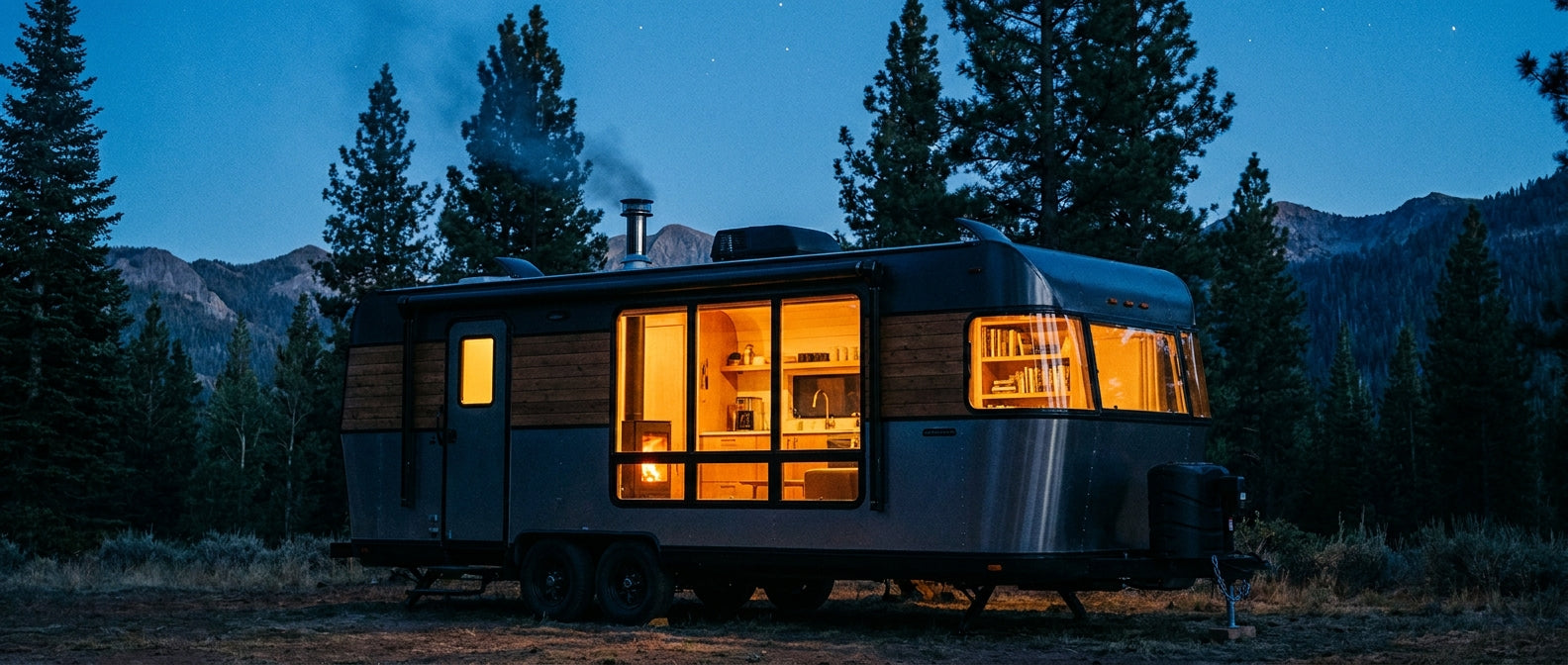
Unlike standard travel trailers, destination trailers feature 8-foot ceilings, bay windows, sliding glass doors, multiple slide-outs, and full-size residential appliances like dishwashers and washer/dryer combos. The interior of a 45-foot model can rival a small apartment, which means your hot water demand, cooling load, and heating requirements look far more like a house than a camper.
Standard RV appliance guides miss this entirely. There's no weight penalty to worry about, you're running on permanent shore power, and occupancy is often higher. Research indicates that 37% of owners experience sizing-related issues with tankless water heaters within the first year. Destination trailer owners are especially vulnerable because their demand profiles sit well above what generic RV guides account for.
Three systems need to be specced correctly for true destination trailer comfort: your rooftop AC, your tankless water heater, and your furnace. Here's how to size each one.
Sizing Your Rooftop AC: Why the Standard 70 BTU/Sq Ft Rule Isn't Enough
The common starting point for RV AC sizing is roughly 70 BTUs per square foot of interior space, with a usable range of 60 to 80 BTU/sq ft. For a standard travel trailer, that rule works reasonably well. For a destination trailer, it consistently underestimates what you need.
The reason is straightforward. Destination trailers are built with panoramic windows, bay windows, and open floor plans that dramatically increase solar heat gain. All that glass admits light and warmth that a conventional travel trailer's smaller windows simply don't. The 70 BTU rule doesn't account for this.
Slide-outs compound the issue. Each large slide-out adds 50 to 80 square feet of cooled space to your calculation. A 40- to 45-foot destination trailer with multiple slide-outs routinely needs dual 15,000 BTU AC units to maintain comfortable temperatures.
If you're parked in an extreme-heat climate (think Arizona, Texas, or inland California), add 20 to 30% to your calculated BTU requirement. Groups of four or more occupants should add another 1,000 to 1,500 BTU on top of that. Bodies generate heat, and in a well-sealed destination trailer, it adds up fast.
The good news: most destination trailers run on 50-amp shore power, which comfortably supports two 15,000 BTU units drawing 13 to 17 amps each. If you ever need to operate on limited power, soft starters reduce AC startup surge by 50 to 65%, making it possible to run a 13,500 BTU unit on as little as a 2,000-watt generator.
Ducted vs. Non-Ducted and Inverter Technology
Destination trailers' multi-room layouts benefit enormously from ducted AC systems. A non-ducted unit cools the area directly below it effectively but leaves bedrooms and bathrooms at the far end of a 45-foot rig uncomfortably warm. Ducted systems distribute cooled air evenly through the entire floor plan.
For stationary rigs on permanent shore power, inverter or variable-speed AC units are worth serious consideration. Units like the Furrion Chill Cube 18K run quieter, provide superior dehumidification, and draw less power at partial load. Since weight savings and generator compatibility aren't concerns, inverter technology is a natural fit for destination trailer living.
Tankless Water Heater Sizing: You Bought a 45-Foot Home — Give It a Home's Worth of Hot Water
Propane tankless water heaters dominate the RV hot water market for a simple reason: an electric tankless unit would require roughly 75 amps of 120VAC power, far beyond the 30- or 50-amp service standard on any RV, destination trailer included. Propane is the only practical fuel source for on-demand hot water in this application.
RV-grade propane tankless units range from 42,000 to 66,000+ BTU, delivering flow rates between 1.5 and 3.9 GPM depending on the model and incoming water temperature. For a weekend camper running one shower at a time, a 2 to 3 GPM unit works fine. A destination trailer with a dishwasher, washing machine, and two bathrooms may need 3.6 to 4+ GPM to keep up with simultaneous demand.
The variable most buyers overlook is cold groundwater temperature. Incoming water at 40°F versus 60°F dramatically reduces effective GPM output at the same BTU rating. If your destination trailer sits in a northern climate where groundwater runs cold for six months of the year, size your heater for worst-case inlet temperatures, not summer conditions.
For four or more occupants running simultaneous appliances, a high-BTU unit with strong flow capacity is essential. The Fogatti InstaShower 9 Pro delivers 66,000 BTU and 3.6 GPM at $709.99, purpose-built for high-demand destination trailer use cases. It matches the residential-grade appliance load these trailers now carry.
The efficiency case is compelling, too. Tankless water heaters are 24 to 34% more energy efficient than conventional tank heaters for typical usage patterns, and they last 20+ years compared to 10 to 12 for tank models. For a semi-permanent setup, that longevity matters.
The industry has taken notice. Forest River's 2025 Campsite Reserve ships with factory-installed tankless heaters alongside dishwashers and ice makers. The factory standard has shifted, and aftermarket upgrades should follow suit.
As the #1 brand in RV tankless water heaters with over 800,000 customers across 80+ countries, Fogatti also serves as an OEM/partner supplier for major manufacturers including Thor Industries, Forest River, and Coachmen. If you're unsure which unit matches your specific load, Fogatti's RV Water Heater Calculator takes the guesswork out of BTU and GPM selection.
Furnace Sizing and Duct Distribution: The Cold-Climate Calculation Most Buyers Miss
The standard rule of thumb for RV furnace sizing is 1,000 BTU per linear foot of rig. A 40-foot destination trailer needs a 40,000 BTU furnace by this measure. That's a useful starting point, but climate adjustments are critical.
For cooler climates, target 45 to 60 BTU per square foot of interior space. In warmer regions where the furnace runs infrequently, 25 to 30 BTU per square foot is sufficient. Common RV furnace sizes are 20,000, 25,000, 30,000, and 40,000 BTU. Large destination trailers often run dual furnaces. The Alliance Benchmark, for example, ships with two 30,000 BTU furnaces and three 15,000 BTU AC units.
Propane consumption adds up quickly. A 30,000 BTU furnace running at a 40% duty cycle averages about 3.14 gallons of propane per day. A 40,000 BTU unit at 60% duty cycle consumes roughly 6.3 gallons daily. Plan accordingly with large-capacity ASME tanks or dual-cylinder manifold systems.
Duct Distribution and Supplemental Heat
A single furnace in a 45-foot, multi-room rig will create hot and cold zones without proper duct design. The master bedroom stays toasty while the front living area hovers at 58°F. Duct distribution is the overlooked factor that separates comfortable rigs from frustrating ones. If your destination trailer has a single furnace, check the duct layout carefully and consider supplemental solutions.
On permanent shore power, electric space heaters and heat strips complement the propane furnace, reduce propane consumption, and improve zone comfort. This hybrid approach is one of the biggest advantages destination trailer owners have over mobile RVers.
Four-season packages from manufacturers like Jayco (Thermal Package) and Keystone (Montana, tested to 0°F) are a strong starting point. Factory specs often need upgrading for true extreme-climate comfort, particularly in duct distribution and insulation at slide-out seals.
Propane Load Management: Running All Three Systems Without Running Dry
When a tankless water heater (up to 66,000 BTU), furnace (30,000 to 40,000 BTU), range, and propane fireplace all share one supply, regulator sizing and line pressure become critical. Add up every appliance that could run simultaneously — that total is your minimum regulator and manifold capacity requirement.
A destination trailer running all major propane appliances at once can easily exceed 120,000 BTU of simultaneous demand. Standard dual-cylinder regulators may not keep up. Cold-climate owners should plan for large-capacity ASME tanks or upgraded dual-cylinder manifold systems with high-flow regulators.
On the electrical side, the 15% growth in solar panel demand across the RV industry reflects a real opportunity. Destination trailer owners can offset AC and appliance electrical loads with rooftop solar, reducing overall propane dependency and keeping more BTU capacity available for heating and hot water. Holistic propane planning is a gap most guides ignore entirely.
Build Your Destination Trailer Comfort Stack With Confidence
The framework is straightforward. Right-size your AC for actual square footage plus window load and slide-out expansion. Choose a high-BTU, high-GPM tankless water heater that matches residential-grade demand. Match your furnace BTU to rig length and climate, and pay close attention to duct distribution.
The timing matters. Park models and destination trailers grew in 2024 while other RV segments declined, driven by rising housing costs pushing consumers toward affordable semi-permanent living. With 342,220 RV units shipped in 2025 and 8.1 million American households currently owning an RV, the destination trailer segment is only gaining momentum.
Fogatti's RV Water Heater Calculator removes the guesswork from tankless sizing, matching your specific occupancy, appliance load, and climate to the right BTU and GPM specs. Every Fogatti unit ships with a 24-month warranty, free phone technical support, and free 1-business-day shipping.
Your destination trailer deserves residential-grade comfort. Spec it that way.