


By: Johnny Walker
Why Your Factory RV Appliances May Already Be Letting You Down
The dealer sold you the rig. Nobody told you which appliances to replace before your first trip.
Here's the reality: RV manufacturers have been decontenting their builds for years, stripping appliances down to the bare minimum to hit lower sticker prices. That means your brand-new trailer likely came with an undersized tank water heater, a basic single-speed AC unit, and heating systems that weren't designed for serious use.
You're not alone in discovering this. According to the RVIA 2025 RV Owner Demographic Profile, 36% of all RV owners are now first-timers, the largest share ever recorded. With the median number of days spent RVing jumping to 30 per year (up 50% since 2021), those factory appliances are getting real stress from day one.
This guide gives you a clear Season 1 decision framework: what to upgrade immediately, what to skip entirely, and what smart additions will pay for themselves before your first season ends.
What to Upgrade Right Away: The Core Comfort Systems
Before you start browsing gadgets and accessories, focus on the systems that define your daily comfort: water heating and climate control. These are the highest-impact upgrades you can make, and they should come before anything else on your shopping list.
This matters when you consider that 45% of new RV buyers cite convenience and ease of setup as key purchasing factors. You want plug-and-play solutions that fit your existing rig without major modifications.
At Fogatti, we've built our reputation as a value-forward alternative to legacy brands: quality engineering, reliable performance, and pricing that doesn't punish you for wanting comfort on the road. Here are the three non-negotiable upgrade categories for your first season.
Water Heater: Ditch the 6-Gallon Tank on Day One
If your RV came with a standard tank water heater, you already know the frustration (or you will soon). These units hold just 6 to 10 gallons and take 20 to 30 minutes to reheat after depletion. For a solo traveler, that's manageable. For a family, that's one shower and then everyone waits. According to The RV Surplus, this is one of the most common pain points new RV owners report.
Tankless water heaters solve this completely. They eliminate standby heat loss by firing propane only when you turn on the tap, making them significantly more energy-efficient than tank models. No waiting, no wasted fuel, and as much hot water as you need.
The Fogatti InstaShower 7 is one of the most popular tankless choices among RV owners right now. It delivers 1.58 GPM of continuous hot water and installs directly into a standard 6-gallon cutout with no major modification required. Priced in the accessible mid-range of the $390 to $1,200 tankless market, it comes with our 24-month warranty and free phone tech support.
This isn't just our recommendation. Major manufacturers like Forest River and Coachmen, both Fogatti OEM partners, now include tankless water heaters as the standard option in their top-selling models. The industry has validated this upgrade path.
Not sure which model fits your rig? Use our free RV Water Heater Calculator to find the right match based on your setup. If you also tent camp or love outdoor showers, check out the Fogatti InstaShower GO, a portable crossover option built for versatility beyond the RV.
Rooftop AC: Sizing It Right Before Your First Hot Weekend
Here's the good news: almost all rooftop RV AC units fit a standard 14" x 14" roof opening. Upgrading from your factory unit doesn't mean cutting a new hole. It's a straightforward swap, according to RVACUnit.com.
Most RVs need between 9,500 and 15,000 BTU of cooling capacity. The factory standard on most travel trailers and Class C motorhomes is 13,500 BTU. That's adequate for many rigs, but you need to match it to your electrical setup.
A 13,500 BTU unit draws approximately 12 to 13 amps at 120V and requires about 3,800 starting watts. Step up to 15,000 BTU and you'll need 5,100 starting watts. This matters, especially if you're on a generator or limited shore power. According to CamperUpgrade, running two AC units on 30-amp service is simply not possible without a soft-start kit. This is one of the most common (and costly) mistakes new RVers make.
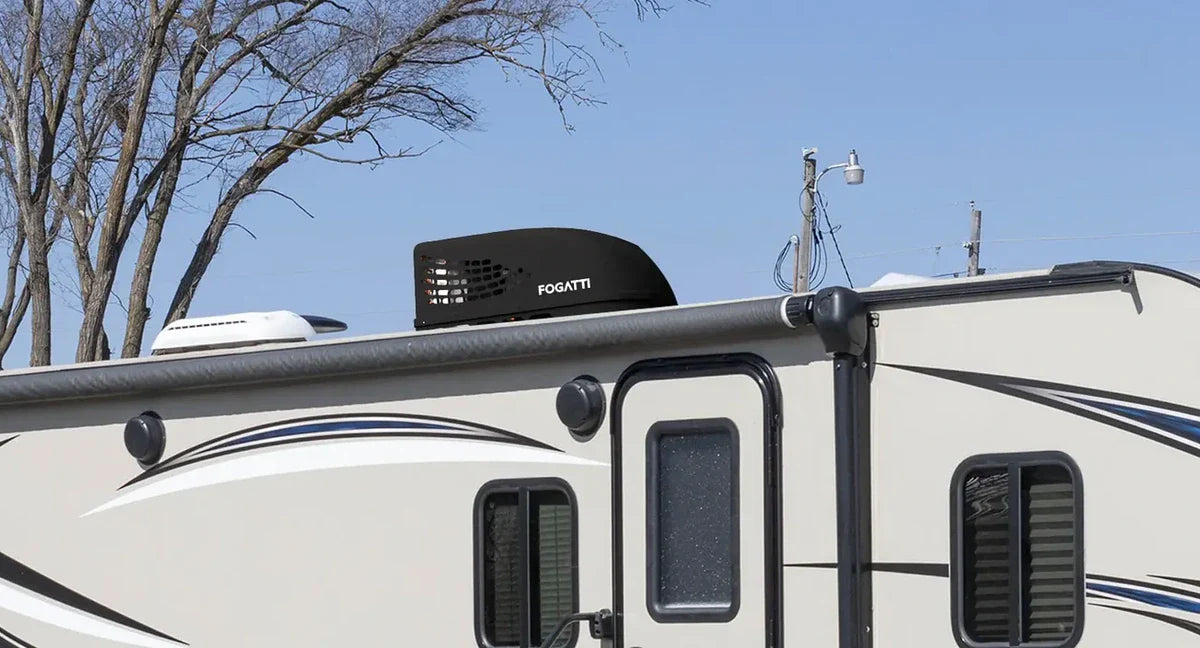
The Fogatti InstaCool series uses inverter/variable-speed compressor technology that avoids the noise, inefficiency, and short-cycling problems of factory single-speed units. According to EPA Energy Star research, properly sized AC units run 25% more efficiently and last 30% longer than oversized systems. Getting the BTU selection right from the start saves you money for years.
One more consideration: during peak season, professional AC installation wait times stretch to one to three months. DIY-friendly units like the InstaCool let you handle the upgrade on your own timeline, so you're not sweating through your first summer waiting for a shop appointment.
Heating: Understanding the Propane Furnace vs. Heat Pump Decision
Many new RVers don't realize their rooftop AC unit likely has a built-in heat pump. That's great for mild weather, but heat pumps only work effectively above approximately 40 to 45°F. Below that threshold, you need a propane furnace. As RV LIFE explains, this is a critical distinction that catches first-timers off guard.
RV propane furnaces consume roughly 1/3 gallon of propane per hour, costing approximately $0.67 to $1.00 per hour at current prices. According to Gone With the Wynns, new RVers who don't understand when to use each system waste hundreds of dollars in their first season alone.
There's also a function most people overlook entirely: your propane furnace's ductwork runs alongside water pipes and into the RV's underbelly. This means it actively helps prevent your plumbing from freezing, something heat pumps and portable electric space heaters simply cannot replicate.
The Fogatti InstaHeat propane furnace is built for exactly this role: a reliable, efficient heat source for cold-weather and shoulder-season camping. Your simple decision rule is this: use the heat pump above 45°F to conserve propane, and switch to the propane furnace below 45°F or whenever you're camping off-grid without shore power. For boondockers and dry campers, propane-powered heating is not optional. It's essential.
What to Skip (At Least in Season 1)
We see it every year: new RVers spend hundreds on gadgets they barely use while their core systems struggle. This is the first-season regret phenomenon, and it's completely avoidable.
Countertop dishwashers are tempting, but they consume significant water and electricity. Most RV water tanks and power budgets simply can't support them practically.
Full-size or pod coffee makers draw high wattage that strains 30-amp systems. A simple pour-over or a 12V option is far more practical in Season 1.
Elaborate smart home gadgets sound exciting, but wait until you understand your rig's actual power budget first. According to SolarTech Online, the average RV uses 20 to 30 kWh of electricity per day, spiking to 50+ kWh in extreme weather. Adding non-essential connected devices before you understand those numbers is a recipe for tripped breakers and frustration.
Spend Season 1 learning your actual usage patterns. You'll make much smarter purchasing decisions in year two with real data behind you.
What to Buy Immediately: The Smart Starter Additions
Beyond your core comfort systems, a few inexpensive additions deliver outsized value from your very first trip.
LED lighting upgrade: Swapping your incandescent RV bulbs for LEDs reduces lighting power consumption by 75 to 85%. It's one of the cheapest, highest-ROI upgrades available.
Soft-start kit for your AC: If you're on 30-amp service, this is essential. It lets you run your air conditioner reliably on a generator or campground pedestal without tripping breakers.
Surge protector/EMS (Electrical Management System): Campground power is notoriously inconsistent. An EMS protects all your appliances from voltage fluctuations, spikes, and miswired pedestals. Buy this before your first trip, not after your first fried appliance.
Converting to energy-efficient appliances broadly can cut overall RV electricity consumption by 20 to 50%, making these early choices a major lever for both comfort and cost control. With Fogatti's fast free shipping (within 1 business day) and 30-day return policy, there's minimal risk in trying new appliances during your first season.
Your First-Season Appliance Budget: What to Realistically Plan to Spend
Here's a realistic budget framework for your Season 1 upgrades:
- Tankless water heater: $390 to $1,200
- Rooftop AC unit: $900 to $2,400, plus $400 to $1,000 for professional installation (or save by going DIY with a unit like the InstaCool)
- Propane furnace: Varies by BTU rating and rig requirements
- Smart starter additions (LED, soft-start, surge protector): $150 to $400 total
Prioritize your spend in this order: (1) water heater, (2) climate control (AC plus heating backup), (3) smart electrical additions. This sequence addresses the highest-impact comfort gaps first.
Fogatti's 24-month warranty and free phone technical support reduce your total cost of ownership and risk as a first-season buyer. Use our free RV Water Heater Calculator to size and budget your water heating upgrade correctly before you spend a dollar.
If you bought an entry-level rig with stripped appliances, upgrading core systems in Season 1 isn't optional. It's the difference between loving RV life and questioning your purchase.
Start Strong: Set Up Your RV for the Long Haul in Season 1
The framework is simple: upgrade water heating and climate control immediately, skip the gadgets, and add smart electrical protection from day one. That's your Season 1 playbook.
You're joining a massive, experienced community. 8.1 million American households currently own RVs, with 16.9 million more planning to buy in the next five years. The upgrade paths are proven. The products are tested. The only question is whether you set yourself up for success now or learn the hard way.
The right appliance choices in Season 1 create a foundation for years of reliable, home-like comfort on the road. Start with our RV Water Heater Calculator to find the right tankless upgrade for your rig, then explore the InstaCool and InstaHeat lines for complete climate control.
Fogatti has been building this since 2003. With 800,000+ customers across 80+ countries and trusted OEM partnerships with Thor Industries, Forest River, and Coachmen, we know what works on the road. Let us help you get your first season right.
Sources
- RVIA 2025 Go RVing RV Owner Demographic Profile
- The RV Surplus — Tankless vs Tank RV Water Heater
- RVACUnit.com — RV Air Conditioner Size Calculator
- CamperUpgrade — RV Air Conditioner Calculator
- SolarTech Online — How Much Electricity Does a Camper Use?
- RV LIFE — RV Propane Heater vs Electric
- Gone With the Wynns — How RV Heating and Cooling Really Work
- CamperFAQs — RV Statistics, Trends, and Facts